



High Smoke Stability

Nutrient Rich

Pure Cold Extraction

Easy to Digest
High Smoke Stability
Nutrient Rich
Pure Cold Extraction
Easy to Digest
Not All Oils Are the Same

Our Cold-pressed oil
Regular Refined Oil
Extraction Process
Extracted at low temperatures (<45°C)
Extracted using high heat (200°C+)
Processing Method
No chemicals No refining
Processed with chemicals & solvents
Nutritional Value
Retains natural nutrients & antioxidants
Stripped of nutrients
Taste and Aroma
Pure aroma, natural taste
Artificial color & odor removal
Overall Quality
Fresh, nutrient-rich oil
Longer shelf life, less nutrition


1
Sourced directly from farmers
We partner with trusted farmers who grow quality seeds using clean harvesting practices - ensuring better raw ingredients from the very beginning.

2
Sortex cleaned & quality checked
Every batch is sortex cleaned to remove dust, stones, damaged seeds, and impurities - so only the best seeds move forward for pressing.

3
Freshly shipped to our mill
Seeds are transported directly to our facility in controlled batches to reduce long storage times and help preserve freshness naturally.

4
Single Cold-Pressed Extraction
Each oil is extracted using a single cold-press cycle at low temperatures, without repeated refining, bleaching, or deodorizing. This helps retain the oil’s natural aroma, antioxidants, and nutrient profile while minimizing heat exposure during extraction.

5
Naturally settled, sealed & delivered
After pressing, the oil is naturally settled and filtered before being sealed in small batches - helping maintain freshness, purity, and flavor until it reaches your kitchen.
Sourced
Sortex
Shipped to us
Singlepressed
Sealed


Your Nose Knows First
-
Cold-pressed oils have a real, natural aroma the moment you open the bottle - because real ingredients actually smell like something.

Why Does the Color Change?
Slight changes in color or texture are normal in natural oils. It’s a sign the oil hasn’t been over-processed to look “perfect.”

Can Oil Change the Taste?
Yes - good oils add personality to food. Mustard, coconut, and sesame oils each bring their own flavor to the final dish.
Cloudy Doesn’t Mean Bad
Natural oils may look slightly cloudy or change over time because they still contain real compounds and nutrients.
Your Nose Knows First
-
Cold-pressed oils have a real, natural aroma the moment you open the bottle - because real ingredients actually smell like something.
Why Does the Color Change?
Slight changes in color or texture are normal in natural oils. It’s a sign the oil hasn’t been over-processed to look “perfect.”
Can Oil Change the Taste?
Yes - good oils add personality to food. Mustard, coconut, and sesame oils each bring their own flavor to the final dish.
Cloudy Doesn’t Mean Bad
Natural oils may look slightly cloudy or change over time because they still contain real compounds and nutrients.
Key Features
Better Fat Structure
Lower Processing Load
More Ingredient Transparency

Feature 1
Feature 2
Feature 3
Cold-pressed oils keep natural fats more intact, helping your body process and use them more efficiently than heavily refined oils.
Your body already handles enough daily stress. Less-processed oils reduce the extra burden created by heavily refined ingredients used every day.
In cold-pressed oils, the seed or nut still defines the aroma, texture, and behavior - making freshness and authenticity easier to notice.
Frequently asked questions
How is black mustard oil different from yellow mustard oil?
Black mustard seeds have stronger pungency, a deeper aroma and a more intense flavour. The oil is deep golden-yellow to amber.
Where are your black mustard seeds sourced from?
Through trusted intermediaries from Bharatpur, Alwar, Sawai Madhopur and Sri Ganganagar in Rajasthan.
Can I deep fry in black mustard cold-pressed oil?
Yes, occasionally. Heat it to its smoking point, let it cool slightly, then add food. Smoke point is approx. 230–250°C. It is not recommended raw or in dressings.
Can I reuse black mustard oil after frying?
No — do not reuse the same oil multiple times, as reheating can form undesirable compounds.
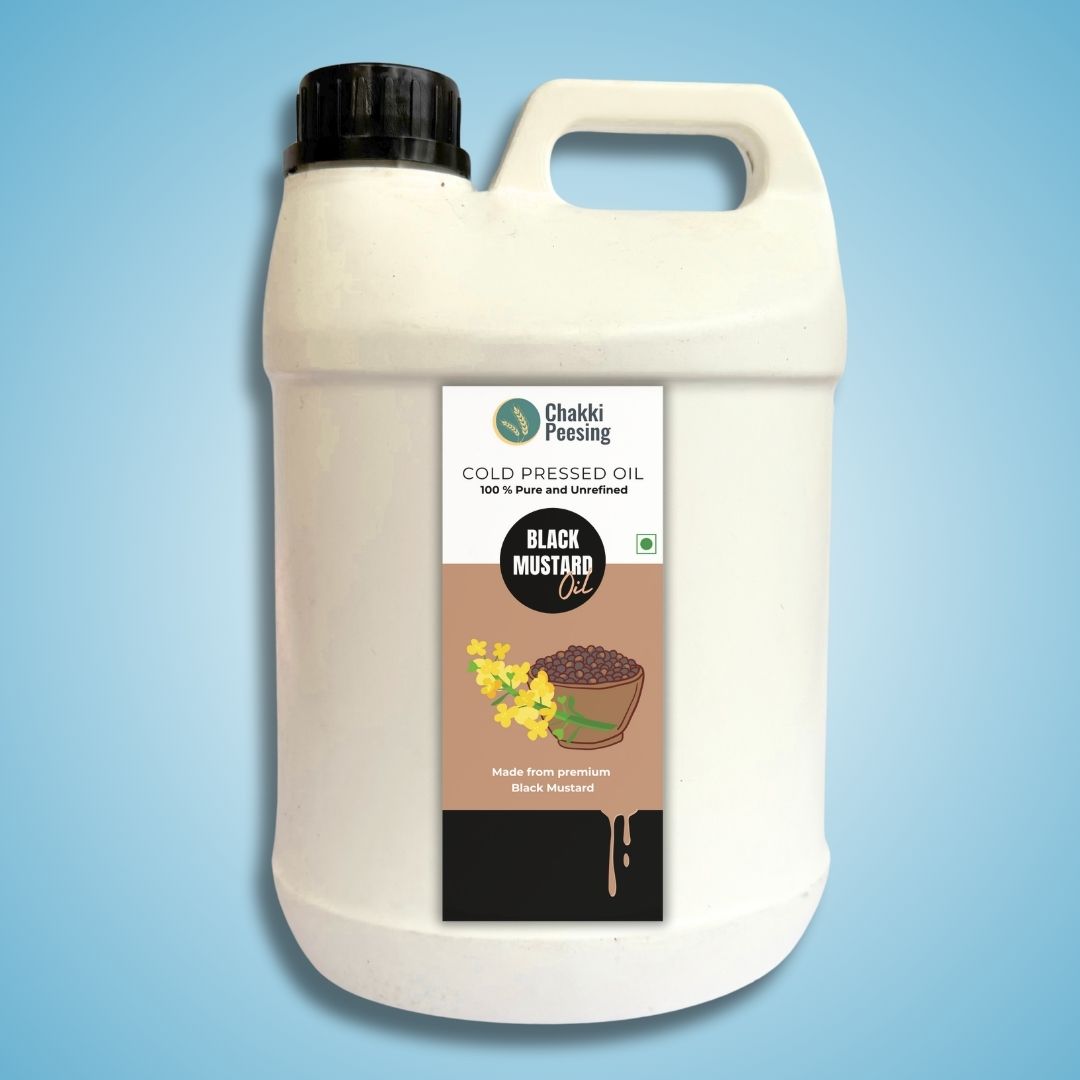
Why is there sediment at the bottom of my Black Mustard Oil bottle?
A thin layer of natural particles can settle at the bottom because of natural sedimentation. It is completely edible and indicates minimal processing; it can happen when sedimentation in the storage tanks is not 100% complete due to weather conditions. Shake gently if needed.
How should I store Black Mustard Cold Pressed Oil?
Store Black Mustard Cold Pressed Oil in a cool, dry place away from direct sunlight and close the cap tightly after use. Cold-pressed oils have a shelf life of 90 days from packaging.
What is Chakki Peesing?
Chakki Peesing is a fresh food brand focused on daily-milled stone chakki flours, single-press cold-pressed oils, freshly ground spices, and carefully sourced grains, nuts, and seeds. We mill only after receiving orders in a small batches to ensure freshness and nutrition.
How are you different from regular packaged brands?
Most packaged brands mill in bulk, store for weeks or months, and rely on preservatives or stabilization methods.
At Chakki Peesing:
- 🌾 Flours are milled fresh every day after order confirmation
- 🥥 Oils are extracted using single-press cold pressing
- 🌶️ Spices are ground in small batches for freshness
- 🚫 No bleaching, no polishing, no additives, no preservatives
Is Chakki Peesing a factory or a local chakki?
We operate a modern, hygienic chakki setup with traditional stone grinding principles, quality checks, and food-grade packaging - bringing the old chakki freshness into a controlled, clean factory environment.
When are flours milled?
All flours are milled fresh every morning.
The first batch is planned using historical demand, and additional batches are milled depending on the day's actual orders.
Are flours milled after I place my order?
Yes. Orders are fulfilled using freshly milled flour from the same day or latest batch, not old stock.
Do you stock flour in advance?
No. We do not maintain long-term flour inventory. Freshness is the core of Chakki Peesing.
Are stones used for grinding?
Yes. All chakki flours are stone-ground, not roller-milled.
Where do you source your grains from?
🤝 We source grains from trusted farmers, mandis, and reliable sourcing partners across India, depending on the crop.
🌾 MP Sharbati Wheat – Madhya Pradesh
🌱 Millets – Rajasthan, Karnataka, Telangana
🍚 Rice – Traditional growing regions
🌶️ Spices – Region-specific sourcing based on origin expertise
Are grains cleaned before milling?
✅ Yes. All grains go through a strict quality process before milling and packing:
🧹 Cleaning – Removal of dust and impurities
🔎 Sorting – Careful grading and selection
🧪 Quality Checks – Batch-level inspection for consistency and freshness
Do you use Sortex cleaning?
We follow multi-level quality checks and sorting processes suitable for small-batch milling. The focus is purity, not mass processing.
Do you use unhulled (with chilka and darker) or hulled kuttu (without chilka and lighter) in your flour
Our kuttu is hulled and is lighter in color. The flour is almost white, maintaining its natural structure and texture. It is minimal processed and fresh ground to maintain its original characteristics
Do you use roasted chana (chickpeas) with or without chilka in your sattu?
Our sattu is made from roasted chana without chilka and is lighter in color , the flour is almost light yellow and fine, maintaining its natural structure and texture. It is minimally processed and fresh ground to maintain its original characteristics. It gives the smooth and fine texture. And you can blend it easily in water making sattu drinks, or other recipes.
Do you use roasted chana (chickpeas) with or without chilka in your sattu?
Our sattu is made from roasted chana without chilka and is lighter in color , the flour is almost light yellow and fine, maintaining its natural structure and texture. It is minimally processed and fresh ground to maintain its original characteristics. It gives the smooth and fine texture. And you can blend it easily in water making sattu drinks, or other recipes.
Why is your Makki Atta fine and not granular like what is available in the market?
Our Makki Atta is finely milled and hence smooth in texture. This results in softer and smoother makki chapattis compared to many coarse makki atta variants available in the market.
Which types of atta do you sell?
We Offer
🌾 Whole Wheat (MP Sharbati, Khapli, Black Wheat)
🌿 Multigrain Blends
🌱 Millets (Jowar, Bajra, Ragi, Makki)
🫘 Pulses (Besan, Sattu)
🪔 Fasting Flours (Kuttu, Singhara, Rajgira)
Is your atta 100% pure?
Yes. Our flours contain only the grain mentioned-no maida, no fillers, no additives.
Is the bran (chokar) removed?
No. Chakki atta retains natural bran, as per traditional stone grinding.
Is the flour suitable for diabetics?
Many customers choose flours like Khapli wheat, multigrain atta, millets, and legumes for better glycemic control.
However, medical advice should always be taken from a doctor or nutritionist.
Is your multigrain atta customisable ?
All our multigrain mixes are pre- fixed formulations and are not customisable. Each mix is prepared in predefined proportions to maintain consistency and quality and achieve specific purpose. Then it's tested and tasted so it fits to make chapatis.Changing this core formula will result in entire composition change and the flour may not be as tasty or easy to roll.
If you want a customised multigrain mix, you can try the "Make Your Own Mix" option on our website.
Can I know the exact formula and % of each ingredient of your multigrain atta?
Due to our proprietary formulation, we're unable to disclose the exact formula of our multigrain atta. However, we're happy to share the category-wise grain % composition and nutritional details with you. This information is available on the website and packs.
What does "cold-pressed" mean at Chakki Peesing?
Cold-pressed oils are extracted at low temperatures without heat or chemicals, preserving natural flavour and nutrients.
Are oils extracted multiple times?
No. We use single-press extraction only.
The oil cake is not re-pressed to increase yield.
Do you refine or deodorise oils?
Never.
No refining, bleaching, deodorising, or chemical processing.
Why does cold-pressed oil sometimes have sediment?
Sediment is natural. Oils are allowed to settle naturally before bottling.
Shake gently if needed.
Are spices freshly ground?
Yes. Whole spices are ground in small batches periodically, not months in advance.
Are spices blended or adulterated?
❌ No. All spices are:
🌿 Single-ingredient
🚫 No added color
🚫 No fillers
🚫 No artificial aroma
Are spices blended or adulterated?
❌ No. All spices are:
🌿 Single-ingredient
🚫 No added color
🚫 No fillers
🚫 No artificial aroma
Why are your Makhana prices higher than other brands? Also how can makhana varieties be graded?
Makhana prices are totally dependent on the size of Makhana and its appearance. Our Makhana prices are higher because we source only "Handpicked makhana" which is the top most export quality grade in Makhana.We source our makhana from Bihar region through intermediaries, which helps us maintain better and consistent quality control and selection.
How are products packed?
All products are packed in food-grade hygienic packaging immediately after milling or processing.
Can we return packaging for reuse?
Due to logistical limitations, we cannot collect packaging back.
Our packaging is recyclable.
How is your packaging better than laminated paper bags?
Laminated paper bags are difficult to recycle due to mixed materials. Our packaging uses similar material layers for easier recycling.
What is the shelf life of fresh flour?
🌾 Since flours are freshly milled:
📅 Best consumed within 15–30 days for optimal freshness but we have tested 45days shelf life
🫙 Store in an airtight container in a cool, dry place
Can flour develop insects?
Fresh atta is more natural and may attract insects if stored improperly.
Always store in airtight containers, preferably refrigerated in summer.
How can I place an order?
Orders can be placed through:
🌐 Chakki Peesing Website
🛍️ Online marketplaces (where listed)
Do you sell in bulk or B2B?
Yes. We cater to:
👩🍳 Home bakers
☕ Cafes
🥗 Dieticians
🏪 Small businesses
Bulk pricing is available on request
Where do you deliver?
We deliver across multiple locations in India, depending on serviceability.
How are delivery charges calculated?
Delivery charges are calculated based on:
- Delivery PIN code
- Total order weight
Do you offer free delivery?
We do not offer free delivery based on order value. but we offer free delivery only in Gurgaon
However, we frequently run discounts and offers.
How long does delivery take?
We grind products only after you place an order to ensure freshness and zero preservatives.
Most orders are processed and shipped the same day after grinding, though this may vary depending on order volume or unforeseen situations.
Enjoy PAN India delivery with quick shipping times:
- Gurgaon: Same-day delivery/ Router Based Delivery/Next Day*
- Delhi-NCR: 2-4 business days
- Other Locations: 3-6 business days
Experience the freshest products, delivered right to your doorstep!
What payment methods are accepted?
We accept:
📲 UPI
💳 Cards
🏦 Net Banking
💵 Cash on Delivery (COD) (where applicable)
Is COD available everywhere?
COD availability depends on location and order value.
Do you accept returns?
All our products are freshly milled , they have a limited shelf life and contain no preservatives. For this reason, our products are generally non-returnable. That said, we completely understand that rare issues can occur, and we are always here to support you in such cases.
For More Information you can check our return policy
What if I receive a damaged or incorrect product?
We request you to inform us within 24 hours of delivery. This short window helps us fairly assess the issue, as freshly milled products cannot be reliably evaluated after a longer time.
For More Information check our return Policy.
What if I don't like the taste?
Taste can vary due to natural crop variation.
We encourage customers to understand fresh, natural food behaviour.
Can I visit your factory?
Yes, factory visits can be planned by informing customer care in advance.
Can I see production areas?
For hygiene and safety:
- Production & warehouse areas are restricted
- Visitors can access the visitor office
Can I buy products directly from the factory?
Yes, orders can be placed during the visit.
Is Chakki Peesing FSSAI compliant?
Yes. We follow all applicable food safety and hygiene regulations.
Is your product "certified organic"?
Our products are naturally sourced from trusted regions/Vendors. They are not certified organic unless specifically mentioned on packets or websites for specific products.
Is your food safe for children and elderly?
Yes. Many customers choose Chakki Peesing for kids, elderly, and health-focused diets.
How can I contact Chakki Peesing?
You can reach us via phone , WhatsApp ( +91 93199 78800), email (care@chakkipeesing.com), or through our website support
Can I bring my own grains for milling at your factory? Do you offer milling as a service?
No, we don't mill outside grain as a service, we only process grains that we source from a trusted partner/ farmer to ensure 100% purity, quality checks, grinding consistency and other food grade standards.
Why is Chakki Peesing priced higher than packaged brands?
Chakki Peesing is priced higher because we mill fresh only after your order—no pre-packing or old stock. We source directly from trusted farms and use traditional stone grinding for better texture and nutrition. There are no preservatives, chemicals, or bulk processing shortcuts.
You're paying for freshness, purity, and small-batch quality—not mass production.
Can you prescribe "Make your own mix" to me based on my need?
The whole idea of "Make your own mix" is based on "Do it yourself,Our MYOM Mix option allows customers to choose ingredients based on their personal preferences or dietary recommendation by a professional. Ingredient selection, proportions and suitability are entirely the customer's responsibility. We do not prescribe, recommend or mix any custom blends for medical,or dietary conditions. For any customised mix or any special requirement we recommend to consult with your health care advisor or dietitian. For our recommendations you can choose one of our multigrain atta, which carries all information.
Is your Kids atta suitable for Infant Consumption
While our products are carefully crafted, lab certified, FSSAI approved. We still advise to look up the ingredient list and take a decision in consultation with their pediatrician.
What is khapli Atta, is it a different grain or millet ?
Khapli is not a different grain or millet, its a variety of wheat only. This is becoming popular because it is a native variety which has been used by mankind for thousands of years. It has less gluten and higher fibre than regular wheat. So people who don't want to give up on the taste of wheat and still want better nutrition can try this.
Black Wheat history?
Black wheat is a naturally pigmented variety of wheat with a dark purple to black color, which comes from anthocyanins, natural antioxidants also found in blueberries. It was developed through traditional breeding methods, not genetic modification, and in India, it was created by scientists at Punjab Agricultural University (PAU), Ludhiana, around 2017 after years of research and trials. The aim was to provide a more nutrient-rich wheat option for daily consumption, and after its development, cultivation gradually expanded to states like Punjab, Haryana, and Madhya Pradesh. Today, black wheat is used to make atta and other wheat-based products, offering both health benefits and unique color to traditional foods.
Can I bring my own grains to be milled in your factory? Do you provide milling as a service?
No, we don't mill outside grain as a service, we only process grains that we source from a trusted partner/ farmer to ensure 100% purity,quality checks, grinding consistency and other food grade standards.
No matching questions.
Ask us on WhatsApp instead
